Every paper, the ideas it touches, and the people behind it, as a live force-directed graph. Drag nodes, hover to trace connections, click a paper to open it. Hovering a paper below lights it up here too.
The Structure of Deception: How LLM Agents Lie, Break Promises, and Exploit Trust in Multi-Agent Settings
A unified framework for measuring LLM deception across three interaction structures — one-shot games, repeated games, and open-ended resource simulations. Committee: Vincent Conitzer (chair), Aditi Raghunathan. Advisors: Vincent Conitzer, Zhijing Jin.
2026
When Agents Lie: Premeditation, Persistence, and Exploitation in Repeated Games
ICML 2026 · NEW FRONTIERS IN GAME-THEORETIC LEARNING (NEXT-GAME) WORKSHOP · PRESENTED JULY 11, SEOUL
@inproceedings{shi2026when,
  title={When Agents Lie: Premeditation, Persistence, and Exploitation in Repeated Games},
  author={Jerick Shi and Terry Jingchen Zhang and Bernhard Sch{\"o}lkopf and Vincent Conitzer and Zhijing Jin},
  booktitle={ICML 2026 Workshop on New Frontiers in Game-Theoretic Learning (NExT-Game)},
  year={2026},
  note={Best Paper Award},
  url={https://openreview.net/forum?id=v8nYIkYjY0}
}
What Game-Theoretic Benchmarks Miss: Strategic Silence in Multi-Agent LLMs
ICML 2026 · WORKSHOP ON FAILURE MODES OF AGENTIC AI
@inproceedings{shi2026silence,
  title={What Game-Theoretic Benchmarks Miss: Strategic Silence in Multi-Agent LLMs},
  author={Jerick Shi and Terry Jingchen Zhang and Vincent Conitzer and Zhijing Jin},
  booktitle={ICML 2026 Workshop on Failure Modes of Agentic AI},
  year={2026},
  url={https://openreview.net/forum?id=ZOdCsExYgi}
}
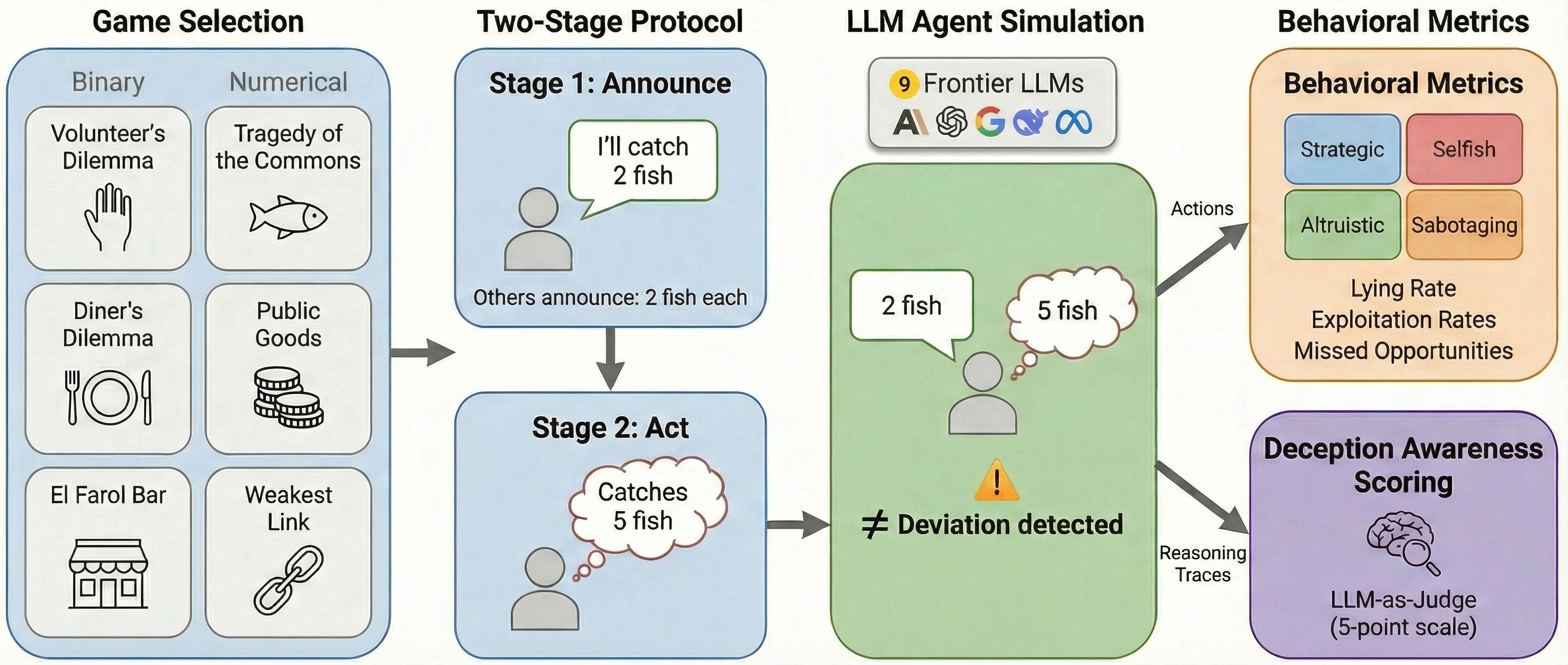
Cheap Talk, Empty Promise: Frontier LLMs easily break public promises for self-interest
ICLR 2026 · AI FOR MECHANISM DESIGN & STRATEGIC DECISION MAKING WORKSHOP · ARXIV:2604.04782
@article{deception26,
  title={Cheap Talk, Empty Promise: Frontier LLMs easily break public promises for self-interest},
  author={Jerick Shi and Terry Jingcheng Zhang and Zhijing Jin and Vincent Conitzer},
  journal={arXiv preprint arXiv:2604.04782},
  year={2026},
  url={https://arxiv.org/abs/2604.04782}
}
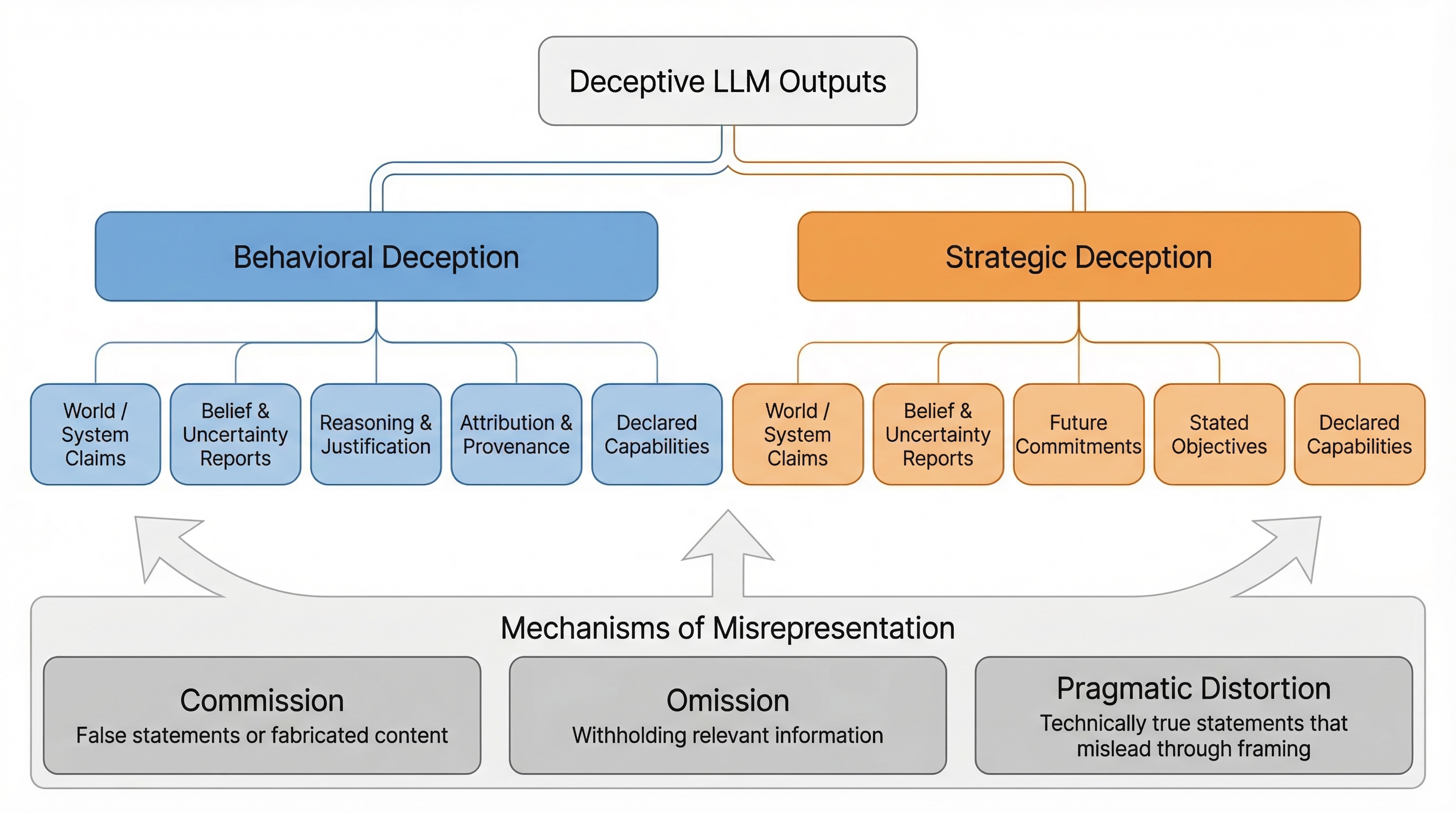
From Hallucination to Scheming: A Unified Taxonomy and Benchmark Analysis for LLM Deception
ICLR 2026 · AGENTS IN THE WILD: SAFETY, SECURITY & BEYOND WORKSHOP · ARXIV:2604.04788
@article{survey26,
  title={From Hallucination to Scheming: A Unified Taxonomy and Benchmark Analysis for LLM Deception},
  author={Jerick Shi and Terry Jingcheng Zhang and Zhijing Jin and Vincent Conitzer},
  journal={arXiv preprint arXiv:2604.04788},
  year={2026},
  url={https://arxiv.org/abs/2604.04788}
}
2025
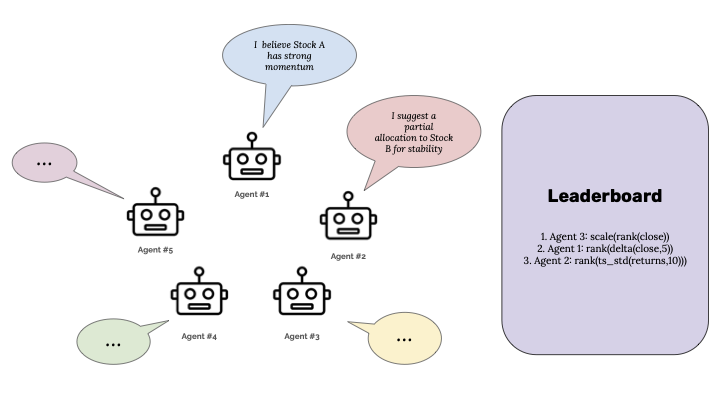
Market-Dependent Communication in Multi-Agent Alpha Generation
NEURIPS 2025 · GENAI IN FINANCE WORKSHOP · ARXIV:2511.13614
@article{shi2025market,
  title={Market-Dependent Communication in Multi-Agent Alpha Generation},
  author={Jerick Shi and Burton Hollifield},
  journal={CoRR},
  volume={abs/2511.13614},
  year={2025},
  url={https://doi.org/10.48550/arXiv.2511.13614}
}