Recruiting season is here, and a lot of people have been asking me some version of the same question. How do I get a job? My resume feels empty, what am I supposed to put on it? My honest answer, which I'll try to say nicely, is that with AI around there are so many things you can try that an empty resume mostly means you haven't started building yet.
A quick disclaimer first. I'm not a recruiter, and I'm not a professional at this in any sense. What I have is a handful of interviews, a job I'm happy with, and a lot of conversations with people on both sides of the process. There are plenty of other perspectives on how to stand out, and this is just one of them.
I could give you a list of projects—simulate Black–Scholes, build a game, ship an app. There are already a million posts like that. I'd rather go one level down and ask why projects are on a resume at all, because the answer tells you what kind of project to build.
What a project is for
A project exists to show something. What it shows depends on the project, but for recruiting I think two things matter most, and the second one sits on top of the first.
Initiative
You picked something, tried it on your own, and made it exist without anyone assigning it to you.
Creativity
You found an angle, an edge case, or a question that the people around you hadn't thought about.
Layer one: initiative
The first thing a project shows is that you're willing to experiment and build something by yourself. That alone separates you from the large number of people who move through college a bit more passively.
This is why I think a personal website is the lowest-effort, highest-reward project you can put on a resume. It used to be a real undertaking. When I started, making a website meant taking a Coursera course on HTML, CSS, and JavaScript, then learning how GitHub works, then fighting with all of it for a weekend. Now you can copy a Jekyll template off GitHub, ask an AI what information it needs from you, hand over your details, and it builds the thing.
From there you can branch. A clean, standard academic layout is completely fine, and it already puts you ahead, since there's now something people can go look at. But if you want it to stand out more, you can just ask for that. My own site is the example I know best. I asked AI to make it more futuristic, add interactive features, and give me a list of ideas, then told it which ones to build. That's why this site looks the way it does. All of it was done with AI, and the prompts behind most of it were a line or two each.
Some people will say they don't know how to push to GitHub or deploy anything. Just learn it. The AI will walk you through every step—including the ones you didn't know to ask about—so I don't think that excuse holds up anymore.
Layer two: creativity
The second layer is creativity. Given something that matters, can you come up with an angle other people didn't?
The clearest example I have is research labs. One of the most common questions I get is how to join a lab when you don't have research experience yet. Small coursework projects help a little, but they rarely make you stand out. The easiest thing I know of is to take some of the lab's own work and push on it. It doesn't have to be big. Replicate a result. Run their model on a different dataset, or with different parameters, and show what changes. Take a small hypothesis you're curious about and test it. Then attach what you found to your application.
That does two things at once. It covers layer one, because you've shown the professor you're willing to put in real work before anyone asked you to. And it shows creativity—if you surface a parameter, an edge case, or a question the lab hadn't looked at, you've demonstrated that you'd add something they don't already have.
This is how I ended up in the Jinesis Lab. Back in undergrad I applied to work with Zhijing Jin for a master's at the University of Toronto, and while she was still deciding, I spent winter break on one of her projects, GovSim, a simulation where a society of LLM agents has to share a common resource without depleting it. The idea I wanted to test was emergent leadership. If you let a group of agents talk to each other, does one of them start acting as a leader? If one does, do the others follow it, and does that keep the simulation alive longer? In the end I decided to stay at CMU for another year. She invited me to join the lab anyway, and I've been working with her since.
Companies and research labs hire for the same underlying reason.
They want someone whose thinking doesn't overlap with the people they already have. Otherwise they could just have their current team use AI.
Being the person who noticed the thing nobody else did, or who asked the question people will remember, is what makes you worth adding.
Where projects sit
The hardest part is usually the first step. To get experience you need experience, and the usual first experiences—internships and research labs—each come with their own version of the question of how you stand out. If you're a freshman, a sophomore, maybe an early junior, there really aren't that many ways.
On one end you're at a very good college with very good grades. On the other end you were extremely gifted in high school, did a lot of competitions, kept doing them in college, and placed in the Putnam top 500, which makes you stand out immediately. Projects sit in the middle. Anyone can do them, and they still carry weight because not everyone is doing them.
The project everyone else is building
There's a category of project I'd steer away from, and it's the stereotypical one. In quant it's a trading bot, or some model everyone has already built. Scroll Instagram and you'll see "top ten coding projects to get into quant," and it's always implement Black–Scholes, build a binomial tree, and so on.
AI can do all of that for you, which makes it easy, and it covers layer one reasonably well. It shows no creativity at all, though, and people in the industry can tell right away that you followed something you found online. Look at some research instead and see whether it gives you an idea. Try something out. You don't need a startup-level idea that nobody has ever had, which would take several steps you probably don't have yet.
Going one or two steps past the stereotypical version is already enough to stand out.
It's also worth saying that technical skill used to be the biggest gap between people who wanted to build something and people who built it. That isn't an excuse anymore. AI can replicate those skills, and it can teach them to you while you work, which is exactly why initiative and creativity matter so much more now. Projects don't showcase technical skill the way they used to, because the AI has it too.
You get better at AI by using AI
Your first project with AI probably won't be great. It won't match what you pictured in your head, and you won't know how to iterate on it. That's normal, and the only fix I know is trial and error. The more you use it, the more you learn which prompts work and which don't, how to describe what you actually want, and how to get the AI to ask you questions so it lines up with your goal. None of those small tricks can be learned without doing it, so my advice is to just start.
What's still ours
This post was mostly about recruiting, but I want to end on something a little broader.
You can delegate almost everything in your life to AI now, and a lot of it will turn out fine. It also makes it very easy to get lazy. So as more people lean on it, the people who still do the work when there's an easier option—who experiment, who take initiative—stand out more. That's my hope for people, honestly: that there will always be some who are willing to try.
Creativity is the other half. Models get better with every release, and they've already swamped pretty much every technical skill out there. There are still parts of human imagination they're far from reaching, and those are the places worth spending your time.
So if I had to name what makes someone stand out in recruiting right now, it's knowing how to use these tools, with initiative and creativity on top.
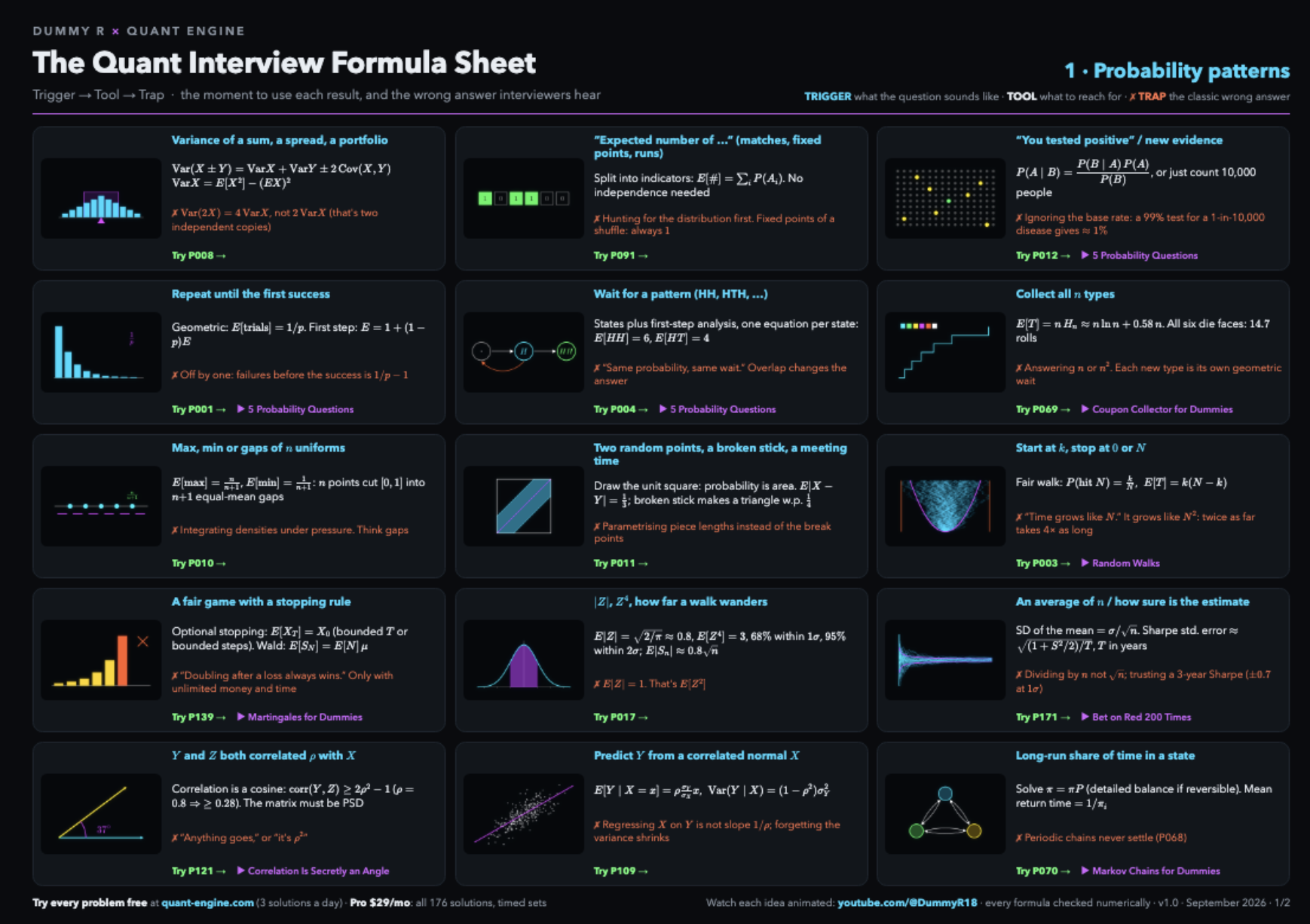
PS: if you want a free quant interview formula sheet, visualized, you can sign up here.